Group Exhibition
Group Exhibition
Les Magiciens de la Terre
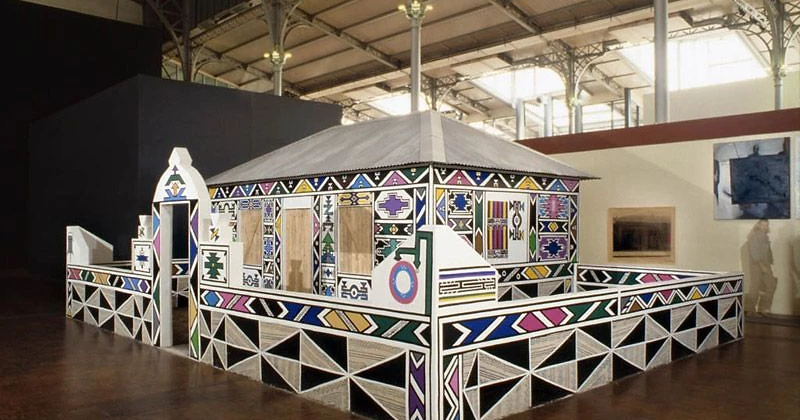
The landmark exhibition that brought Mahlangu to international attention. A full-scale replica of her house was constructed, which she painted before an audience of thousands.
Venue
Centre Pompidou & Grande Halle de la Villette
Location
Paris, France
Dates
18 May – 14 August 1989
A Landmark Exhibition
Curated by Jean-Hubert Martin, Les Magiciens de la Terre (Magicians of the Earth) opened in Paris on 18 May 1989 as one of the most ambitious and controversial exhibitions of the late twentieth century. Presented simultaneously at the Centre Georges Pompidou and the Grande Halle de la Villette, it brought together one hundred artists from across the globe — fifty from the so-called centres of the Western art world and fifty from its margins — and placed their work side by side on equal footing.
The exhibition was conceived as a direct response to the Museum of Modern Art's 1984 Primitivism show, which had been widely criticised for presenting non-Western objects as mere sources of inspiration for Modernist masters rather than as works of art in their own right. Martin sought to dismantle this Eurocentric framework, identifying every artist — Western and non-Western alike — by name, as individuals rather than as representatives of a region or a tradition.
Esther Mahlangu's Participation
Dr Esther Mahlangu was the only South African artist invited to participate. Rather than being asked to show paintings on canvas, she was invited to construct and paint a full-scale replica of her Ndebele homestead within the vast interior of the Grande Halle de la Villette. Over the course of the exhibition's installation, she worked on the structure in situ, painting its walls with the bold geometric patterns that are the matrilineal heritage of Ndebele women — a tradition passed down across generations.
Thousands of visitors watched as she transformed the space, bringing a living architectural tradition into one of Europe's most prestigious contemporary art venues. The house stood as both a complete work of art and a powerful statement: that the domestic, the vernacular, and the ritual could hold their own alongside the most celebrated works of the international avant-garde.
A Turning Point
Les Magiciens de la Terre marked the moment Dr Mahlangu was introduced to European audiences. The exhibition's international critical attention opened doors that would define the next three decades of her career — from the BMW Art Car in 1991 to museum retrospectives across the world. The show itself remains a watershed in the history of curatorial practice, widely debated and continually revisited for its attempt to reframe the relationship between Western and non-Western art on genuinely equal terms.